Honduras: Climate Adapted Homes and Resilient Basic Services

Ariana Karamallis
Director of Global Engagement
The Challenge: Climate-Induced Displacement in the Sula Valley
Honduras’ Sula Valley is one of the most critical economic engines of this Central American nation. Nestled in the northeast, serves as a key agricultural and industrial hub and is home to Puerto Cortés, a major port driving trade with Europe and North America. However, this region is also highly vulnerable to climate change. In 2020, during the COVID-19 pandemic, back-to-back Hurricanes Eta and Iota exposed this vulnerability, devastating the region with catastrophic flooding.
For local families, extreme weather threatens a brutal cycle of displacement. Floods can routinely render homes uninhabitable, forcing residents into inadequate, unsafe temporary shelters far from their jobs and support networks. This involuntary, climate-driven migration carries heavy socioeconomic and psychological tolls—and when workers are displaced, the ripple effects can destabilize the entire Honduran economy.
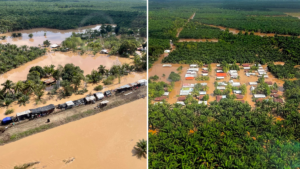
For low-income communities, the physical quality of a home is the primary defense against a “displacement cascade.” where the loss of shelter triggers a total collapse of household stability. Research on structural vulnerability—particularly in informal or under-resourced areas—shows that when housing lacks the integrity to withstand extreme wind or water, a single climate event can result in the permanent loss of both physical and social capital.
Unlike wealthier populations who may have the insurance or liquid assets to rebuild, low-income residents become trapped in a “repair-and-repeat” cycle, exhausting their resources on recurring minor damages until they are forced to abandon their land. This involuntary migration risks severing essential social networks, disrupts children’s education, and terminates local livelihood opportunities, thereby entrenching long-term poverty.
The Solution: A Safe Haven Above the Floodwaters
Prioritizing structural resilience and flood-mitigation retrofits is one of the most cost-effective ways to ensure housing security, allowing vulnerable populations to remain anchored in their communities and transition from a state of constant survival to one of social development.
In 2022, recognizing that keeping people safely in their homes is key to both human dignity and economic stability, Build Change launched a pioneering climate-resilient housing program. Partnering with the Honduran Red Cross, the initiative combined Build Change’s deep technical expertise in structural retrofitting with the Red Cross’s frontline emergency response experience.
The program targeted the disaster-prone communities of Lupo Viejo (in the municipality of Choloma) and Portrerillos. The pilot phase successfully upgraded 8 homes, with additional work underway to promote long-term systems change for climate resilient housing in the region.
This innovative approach was quickly recognized on the world stage, named by the Latin American Development Bank (CAF) as one of the top 10 innovations for social impact in Latin America in 2022.
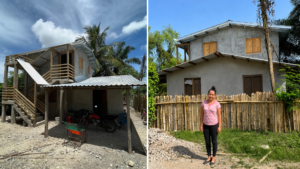
The Innovation: A “Dry” Second Story and Off-Grid Utilities
To make it possible for families to safely stay in their homes, Build Change created a climate adaptive retrofitting solution that structurally strengthens existing single-story homes to withstand earthquakes and high winds, while introducing life-saving adaptations for floods:
- An Elevated Safe Refuge: Homes are strengthened and expanded to include a “dry” second story. This upper level provides a safe space for families to wait out rising waters or await rescue, keeping them out of emergency shelters. It also doubles as extra living space or room for home-based businesses during normal times.
- Resilient Water and Sanitation: The second story features a fully functional bathroom connected to a rainwater harvesting system. Equipped with an 1,100-liter tank, the system provides a typical family with an entire week’s worth of clean water.
- Green & Independent Energy: The retrofits include photovoltaic (solar) panels to ensure families have access to affordable electricity, even when the main power grid fails during a storm.
- Environmental Protection: By installing biodigesters, families avoid soil and groundwater contamination that typically occurs when traditional septic tanks are flooded during hurricanes.
Driving Long-Term Systems Change
To ensure this isn’t just a one-off project, Build Change is focused on influencing housing and community infrastructure systems to advance resilience across the board.
Build Change trained the local workforce to scale the climate-resilient housing solution, working directly with local builders, engineers, students, and government officials to build their capacity to replicate these resilient designs.
Additionally, we are now supporting 3 municipalities in Sula Valley to assess, design & implement climate resilient upgrading projects for primary health care centers, in the hopes of ensuring that all essential community infrastructure is resilient to climate change impacts and to which the project extends its gratitude to the Government of India for its financial support through the Coalition for Disaster Resilient Infrastructure’s Resilience Accelerator Fund (CDRI – IRAF).
From the Ground: Expert Perspective
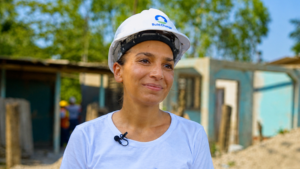
“Every year floods occur more frequently in this area, and every year the water levels are rising. We are giving the community the opportunity to adapt to climate change in preparation for future emergencies. We are substantially retrofitting existing one-story homes and expanding part of them to a second story to create a safe refuge where people can wait until the water levels subside or wait for emergency crews to arrive to help them.”
— Anna Pavan, Engineering Program Associate, Build Change
Learn More
To learn more, check out these resources:
Support resilient housing worldwide
Join us in preventing housing loss caused by disasters.
Donate nowNewsletter
Sign up for our newsletter to receive updates on our latest news, events, and more.