From Recognition to Action: A Turning Point For Housing Resilience

Ariana Karamallis
Director of Global Engagement
From Recognition to Action: A Turning Point for Housing Resilience
Resilient housing is not a peripheral development issue. The first half of 2026 has demonstrated something that Build Change has long argued: safe, resilient housing must be recognized as a prerequisite for climate adaptation, disaster risk reduction, sustainable urbanization, and equitable development.
Across global policy platforms, housing has moved to the center of conversations about cities, climate and resilience. This shift reflects a growing understanding that for billions of people, climate vulnerability begins at home. When homes are unsafe, poorly constructed, or located in high-risk areas, hazards become disasters and humanitarian crises. When housing is resilient, communities are better equipped to withstand shocks, recover faster, and build long-term prosperity.
The momentum is encouraging. The challenge now is ensuring that political recognition translates into policy change, financing, and implementation at scale.
Housing is Rising on the Global Agenda
Over the past six months, Build Change has been privileged to contribute to several major international policy discussions that illustrate the growing prominence of housing within the climate and development agenda.
At the Sustainable Buildings & Construction Summit, Build Change co-hosted a workshop titled “Scaling Resilience Across the Global South: Self-Built Housing as a Pathway to Safer, Climate-Ready Communities.” The discussion challenged conventional assumptions about housing delivery by recognizing that much of the world’s housing is self-built and incremental. Rather than viewing this reality as a problem to eliminate, participants explored how governments, technical experts, financial institutions, and communities can support safer construction practices that improve resilience while preserving inclusivity and affordability.
At CBA20, our session on “Radical Housing Justice: Community-Led Adaptation in Informal Settlements” highlighted some of the most effective solutions to climate and disaster risk led by communities themselves, while also identifying the structural barriers that prevent these grassroots initiatives from being supported by national policy and climate finance. Grounding the conversation in the principles of housing justice, the session explored the policy reforms and paradigm shifts needed to ensure that climate adaptation empowers historically marginalized communities rather than leaving them behind.
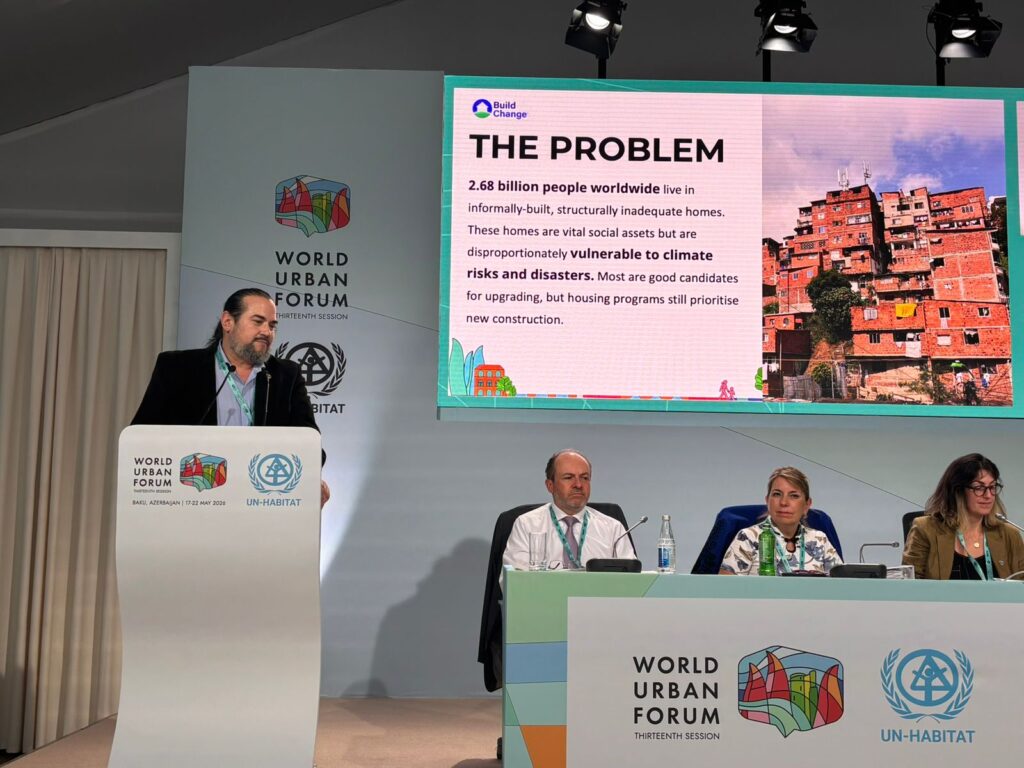
Perhaps most significantly, WUF13 and the Baku Call to Action placed housing squarely at the center of international discussions. Build Change was honored to participate in multiple speaking engagements, including the high-level dialogue on Housing at the Centre of Crisis Recovery and Reconstruction, where we brought our experience of delivering disaster-resilient housing solutions in informal contexts into broader conversations on housing and crisis response.
A key message throughout these engagements was the need to elevate the qualitative housing deficit—the millions of existing homes that are unsafe, inadequate, or highly vulnerable to climate and disaster risks—to the same level of priority as the quantitative housing shortage. Addressing the global housing crisis cannot rely solely on building new homes; it also requires investing in the structural upgrading and climate resilience of existing housing through homeowner-driven and community-led approaches. Achieving this will depend on ensuring that resilient housing policies, financing mechanisms, and implementation programmes are accessible to the people living in informal housing and settlements, where the need—and the opportunity for impact—is greatest.
Across these engagements, a common message emerged: housing is increasingly understood as both a climate issue and a development issue.
The Urban Future Will Be Built in the Global South
This policy momentum is particularly important given the scale of urbanization now underway.
Over the coming decades, the majority of global urban growth will occur in Africa and other parts of the Global South. Hundreds of millions more people will re
quire access to adequate housing, infrastructure, and basic services. The built environment that emerges during this period will shape not only economic opportunity but also global climate outcomes.
This represents both an extraordinary opportunity and a significant risk.
If urban expansion follows patterns of unsafe construction, inadequate planning, and exclusion from formal housing markets, climate vulnerability will deepen while emissions and disaster losses increase, and informal settlements will continue to expand in hazard-prone areas where residents face repeated cycles of destruction and recovery.
Conversely, if governments and partners invest in resilient and inclusive housing systems, this urban transition can become one of the world’s greatest opportunities for climate adaptation and sustainable development.
The choices made today will determine whether rapidly growing cities become engines of resilience or concentrations of risk.
Moving Beyond Recognition to Implementation
While housing is gaining visibility in international policy discussions, recognition alone is not enough.
Meaningful progress requires corresponding shifts in how resources are allocated by official development assistance agencies, multilateral development banks, climate funds, and other financial institutions. Investments must increase support and shift priorities from new housing construction to upgrading and strengthening existing homes and informal settlements where billions of families already live.
Disaster resilience cannot be achieved simply by relocating vulnerable populations. Build Change’s experience has consistently demonstrated that the most effective approach is often to remove the risk, not the people—supporting safer construction, resilient retrofitting, and community-led upgrading that allows residents to remain connected to their livelihoods and social networks.
Technical assistance, appropriate regulatory frameworks, innovative financing mechanisms, and locally driven implementation all have essential roles to play. Civil society organizations, grassroots groups, and technical experts bring practical knowledge that can help governments translate ambitious policy commitments into effective action on the ground.
Looking Ahead: Critical Opportunities for 2026
The second half of 2026 presents several important opportunities to accelerate this agenda.
The review of SDG 11 at the High-Level Political Forum and the midterm review of the New Urban Agenda should recognize housing resilience as fundamental to achieving inclusive, safe, resilient, and sustainable cities. Housing is not merely one component of urban development—it is the foundation upon which health, economic opportunity, disaster resilience, and climate adaptation depend.
At the same time, the Intergovernmental Council for Buildings and Climate (ICBC) and the UN Habitat Open-Ended Intergovernmental Expert Working Group on Housing have the potential to become meaningful platforms for moving from global commitments to local implementation. Member States should leverage these mechanisms to strengthen local regulatory frameworks, expand access to finance, improve construction practices, and support resilient housing upgrades, particularly for households living in informal settlements.
For Build Change, this means continuing to bring practical experience from the field into global policy discussions. Our work demonstrates that resilient housing is achievable even in contexts of informality when technical expertise is combined with community leadership and supportive public policy.
Finally, attention is already turning toward COP31 in Türkiye and, beyond that, COP32 in Addis Ababa. As the climate agenda increasingly engages with cities and the built environment, it is essential that it remains grounded in the realities of the majority world. The future of climate adaptation will largely be determined not by flagship projects in wealthy cities, but by whether families living in informal housing across the Global South can access community-centred, inclusive, and affordable upgrading solutions that strengthen resilience without perpetuating exclusion or displacement.
The momentum is real and the conversations are changing. The next challenge is ensuring that this growing recognition results in policies, financing, and partnerships that improve lives at scale.
Housing resilience is no longer simply a housing issue—it is a climate imperative, a development imperative, and one of the defining opportunities of our urban future.
Support resilient housing worldwide
Join us in preventing housing loss caused by disasters.
Donate nowNewsletter
Sign up for our newsletter to receive updates on our latest news, events, and more.